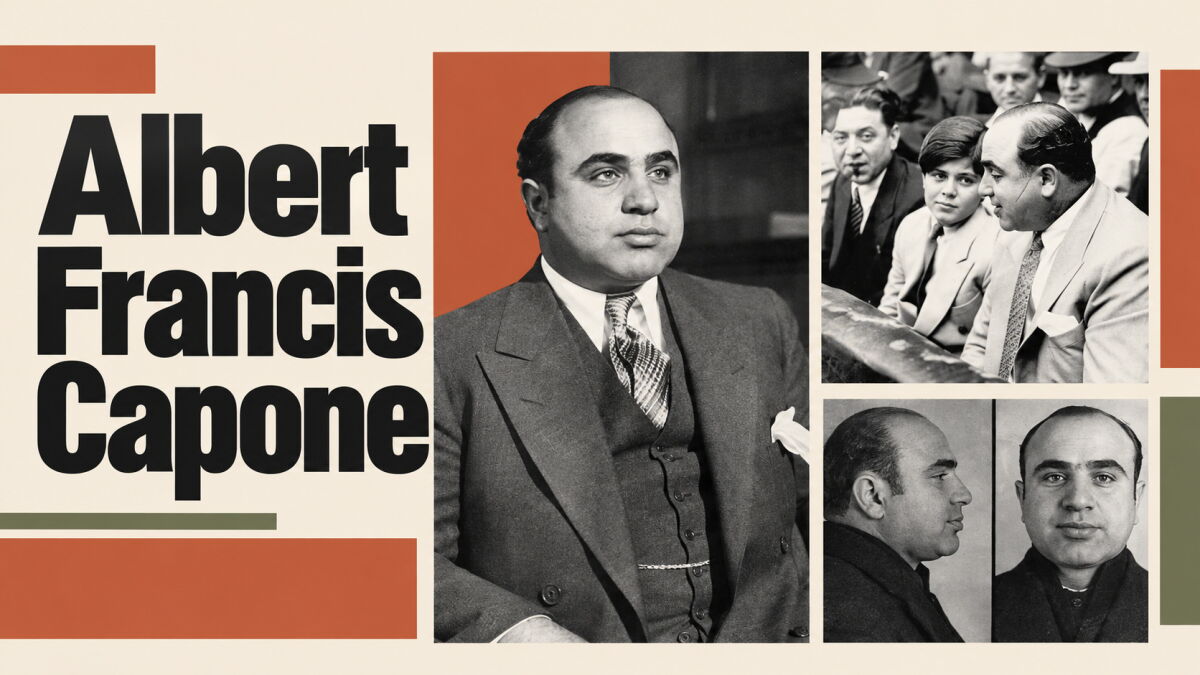
Basic Information
| Field | Details |
|---|---|
| Full Name | Albert Francis Capone |
| Nickname | “Sonny” |
| Also Known As | Albert Francis Brown (after 1966 legal name change) |
| Born | December 4, 1918, Brooklyn, New York |
| Died | 2004 (some public records vary on the exact day) |
| Parents | Alphonse “Al” Capone and Mae (Mary Josephine) Coughlin |
| Spouse | Diana (Diane) Ruth Casey, m. early 1940s |
| Children | Four daughters: Veronica, Teresa, Barbara (Barbara Mae), Patricia (often Diane Patricia) |
| Education | St. Patrick’s (Miami Beach); briefly University of Notre Dame (1937–1938); B.S., Business Administration, University of Miami (1938–1941) |
| Occupations | Aircraft depot/assembly worker (WWII era), flower shop proprietor, used-car and insurance salesman, restaurant owner |
| Notable Events | 1960s family lawsuit vs. producers of The Untouchables; 2021 auction of family artifacts by descendants |
| Residences | New York; Miami; later California (including the Sierra foothills) |
Early Life: A Child in the Crosshairs of Fame
Albert Francis Capone was born on December 4, 1918, while the 20th century’s most infamous criminal was still an ambitious young man. Sonny arrived just as Al Capone’s orbit was widening—from Brooklyn to Chicago, from street muscle to the throne of the Chicago Outfit. Yet the family home, guided by Mae’s steady hand, tried to be ordinary. He battled early health issues, including a mastoid infection and reported hearing loss, and was coddled by parents who wrote affectionate letters and saved family photographs like talismans against the public storm.
Sonny grew up learning two languages: English and secrecy. The surname was a key that unlocked gawking stares and slamming doors. Later, as the country’s appetite for prohibition lore swelled, he learned the art of being visible without being seen.
Education and the Quiet Dream of Normalcy
School was a refuge. After time at St. Patrick’s in Miami Beach, Sonny briefly enrolled at the University of Notre Dame in 1937–1938, a Midwestern detour into tradition and anonymity. He then returned to Florida to complete a B.S. in Business Administration at the University of Miami between 1938 and 1941. Those years mapped out the contours of the life he wanted: respectable, predictable, and mercifully unremarkable.
The diploma did not come with a neon sign. It came with options. He took them.
Work: Ordinary Jobs, Extraordinary Caution
While his father’s name conjured smoky back rooms and ledger books written in code, Sonny chose work that anyone could recognize at a glance. During the war years he found a place in aircraft assembly and depot operations, one gear in a massive national machine. Afterward, he tried his hand at a flower shop. He sold used cars. He sold insurance. He helped run or owned a restaurant at points in his life. These jobs signaled a clear thesis: a straight line is the shortest path away from infamy.
To some, the list reads like underachievement. To Sonny, it read like freedom—the freedom to stand at a counter, shake hands with a customer, and never once worry about a wiretap.
Marriage and Children: A Family of Daughters
In the early 1940s, Sonny married Diana (Diane) Ruth Casey. Together, they had four daughters: Veronica (Ronnie), Teresa (Terry), Barbara (Barbara Mae), and Patricia, who is widely known as Diane Patricia. The daughters would come to carry the complicated family story forward. Their voices—warm, frank, sometimes wistful—offered glimpses of a grandfather who made breakfast and told jokes, a grandmother steady as a lighthouse, and a father whose greatest rebellion was the insistence on a normal life.
Over time, the family story passed to grandchildren who grew into public voices of their own, sharing memories, publishing books, and, later, stewarding the tangible remains of a life: letters, photos, a treasured keepsake or two once stored in boxes in a closet.
The Name Change: Shedding a Skin
In 1966, Albert Francis Capone legally changed his surname to Brown. It was not a theatrical gesture but a quiet molt, an attempt to slip the skin that history had glued to his back. The new name fit like a plain coat worn in rainy weather—durable, anonymous, and protective. Under it, he moved through grocery stores and PTA meetings as a man among neighbors, not a headline among gawkers.
Later, he lived in California, spending years in the Sierra foothills in a community that valued privacy and the slow cadence of everyday life.
Legal Battles and Public Moments
The family’s determination to control their image—if only to preserve some dignity—sparked a headline-making legal battle in the 1960s. Mae Capone and her son joined a lawsuit that argued television portrayals in The Untouchables violated privacy and caused harm. The courts disagreed, finding that the law’s shield did not extend as far as they hoped, especially for relatives of a public figure. It was a civic sequel to the family’s decades-long negotiation with fame: another reminder that a notorious name can be a public utility.
Decades later, in 2021, the family allowed the public a curated walk through their memories. They auctioned letters, photos, personal effects—items that had crossed state lines in moving trucks and sat on family shelves for generations. The sale was less a rummage of relics than a punctuation mark: a way to organize the past and turn a page.
Selected Timeline
| Year | Event |
|---|---|
| 1918 | Born in Brooklyn on December 4. |
| 1920s–early 1930s | Childhood between New York and, later, Miami; ongoing health issues reported. |
| 1937–1938 | Enrolls at the University of Notre Dame. |
| 1938–1941 | Completes a B.S. in Business Administration at the University of Miami. |
| Early 1940s | Marries Diana Ruth Casey; the couple later have four daughters. |
| 1940s | Works in aircraft assembly/air depot during WWII era; afterward takes on various civilian jobs. |
| 1960s | Family lawsuit challenges TV portrayals in The Untouchables; claims are dismissed. |
| 1966 | Legally changes surname to Brown. |
| 2004 | Dies; public records differ on the exact day. |
| 2021 | Descendants auction family artifacts, sparking renewed public interest. |
Family Members at a Glance
| Name | Relation | Lifespan | Notes |
|---|---|---|---|
| Alphonse “Al” Capone | Father | 1899–1947 | Chicago Outfit boss; remembered by family as a devoted, if complicated, parent. |
| Mae (Mary Josephine) Coughlin Capone | Mother | 1897–1986 | Family anchor who managed the household through fame, illness, and litigation. |
| Diana (Diane) Ruth Casey | Spouse | 1919–1989 | Married Sonny in the early 1940s; mother of their four daughters. |
| Veronica | Daughter | — | Often called Ronnie; part of the family’s quieter branch. |
| Teresa | Daughter | — | Known as Terry; preserved family memories with her sisters. |
| Barbara (Barbara Mae) | Daughter | — | Appeared with sisters in select public moments. |
| Patricia (Diane Patricia) | Daughter | — | A primary public voice for the family; author and interviewee. |
Money and Myth: The Question of Wealth
The mythology surrounding Al Capone’s fortune has long overshadowed his son’s finances. Sonny did not inherit an empire; he inherited a cautionary tale and a surname frequently tied to tax liens and government scrutiny. No credible public estimate pegs him to sizable wealth. The family’s later auction showcased mementos rather than a vault of riches—letters, photos, and personal items rather than stacks of bonds.
In the end, the most valuable assets he carried were intangible: new routines, a plain name, a family story preserved at the kitchen table.
What Made Sonny Different
In the American imagination, gangster sons become gangster princes. Albert Francis Capone wrote his own plot. He chose jobs with W-2s, not aliases; schools with deans, not dons. If his father’s life was a roaring furnace, his was a steady pilot light—still warm, still human, but not designed to scorch.
The paradox is that his anonymity became his legend. The more he said “no” to spectacle, the more people looked for it. The family’s public glimpses—interviews, memoirs, an auction—only reaffirmed the central theme: Sonny was the man who lived with the weight of a world-famous surname and carefully set it down.
FAQ
Did Albert Francis Capone work in organized crime?
No. He built a conventional life and worked in everyday jobs far from his father’s underworld.
Why did he change his name to Brown?
To escape the burden and scrutiny attached to “Capone,” he legally changed his surname in 1966.
How many children did he have?
He and his wife, Diana Ruth Casey, had four daughters: Veronica, Teresa, Barbara, and Patricia (often known as Diane Patricia).
What happened with the family’s lawsuit over The Untouchables?
The courts dismissed the claims, ruling that relatives of a public figure could not claim the privacy protections they sought.
When did Albert Francis Capone die?
He died in 2004; some public records differ on the exact day.
Did he inherit Al Capone’s wealth?
No clear evidence indicates he inherited significant wealth; his life was largely middle-class and low-profile.
Where did he live later in life?
He spent later years in California, including time in the Sierra foothills.
What was his education?
He briefly attended Notre Dame (1937–1938) and earned a business degree from the University of Miami (1938–1941).
Why is there renewed interest in his story?
A 2021 family auction of letters and personal items rekindled public curiosity and added texture to the family narrative.
How do his descendants remember him?
As a private, steady father and grandfather who chose ordinariness over notoriety and guarded the family’s dignity.