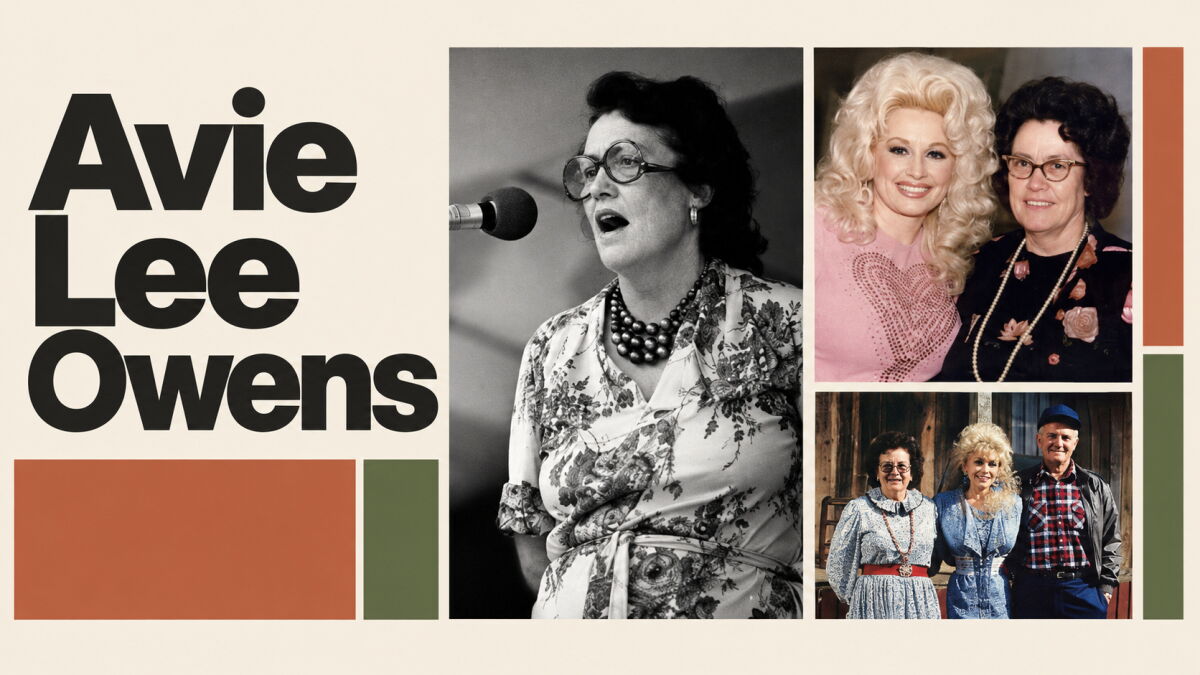
Basic Information
| Field | Details |
|---|---|
| Full Name | Avie Lee Caroline Owens Parton |
| Birth | October 5, 1923 |
| Birthplace | Lockhart, Union County, South Carolina, USA |
| Death | December 5, 2003 (age 80) |
| Place of Death | Sevierville, Sevier County, Tennessee, USA |
| Parents | Rev. Jacob “Jake” Robert Owens and Rena Kansas (Valentine) Owens |
| Heritage | Welsh and Scots-Irish |
| Religion | Pentecostal background |
| Spouse | Robert Lee Parton Sr. (m. August 17, 1939; d. 2000) |
| Children | 12 (including Dolly Rebecca Parton; one infant son, Larry, deceased 1955) |
| Occupations | Homemaker; singer; guitarist |
| Associated Places | Locust Ridge and Sevierville, Tennessee; Great Smoky Mountains |
| Known For | Musical influence on her children; family gospel singing; inspiration for “Coat of Many Colors” |
Early Roots in Carolina and the Smokies
Avie Lee Owens was born on October 5, 1923, in Lockhart, South Carolina, a cotton-farming community where faith and fiddle tunes braided through daily life. Her father, Rev. Jake Owens, preached the Word and played the bow, melding scripture with song. Her mother, Rena, kept the home and carried forward a thread of Welsh and Scots-Irish balladry. In this musical, devout household, Avie Lee learned that melody could be a meal when bread ran low, and that stories—ancient and local—were a family’s heirloom.
By her mid-teens, the Owens family had ties in the hills of East Tennessee. At 15, on August 17, 1939, Avie Lee married Robert Lee Parton, a hardworking farmer from Sevier County. The young couple settled near Locust Ridge in the Great Smoky Mountains, where roads were rutted, winters were stern, and a single room might shelter a dozen dreams.
Marriage at Fifteen, a House Full of Voices
From 1940 to 1959, Avie Lee bore 12 children—an astonishing span of motherhood compressed into 19 years. Poverty shadowed the family, but it never muted them. Their home echoed with harmony and hope, the children lined up like choir parts: soprano to bass, tremulous to bold. They canned vegetables, patched clothes, and hauled water; they also learned to sing.
Avie Lee’s resourcefulness was legendary. She could turn an old coat into a technicolor testament to love, and a cornhusk into a cherished toy. When spirits lagged, she lit the lamp of story—sometimes a “stone soup” tale where a single shining pebble could feed a hungry heart. The lesson was consistent: love multiplies what little you have.
Songs by Lamplight: Faith, Folklore, and a 1968 Family Gospel Album
Music was not a hobby in the Parton home; it was a lifeline. With a gentle alto and a steady guitar, Avie Lee passed down centuries-old ballads and church hymns along with mountain lore. She favored songs with marrow—gospel numbers that rose from hard ground and rain-slick roads. In 1968, she joined daughters Willadeene, Stella, and Cassie on a gospel project often referred to as The Parton Family’s gospel album, a rare recorded glimpse of the music that nourished their household. Selections like “Mama Sings” captured the timbre of her voice—plain-spoken, expressive, unwavering.
Her influence on Dolly is indelible. She supplied the raw material for “Coat of Many Colors,” a family parable stitched from scraps; she inspired childhood pieces like “Little Tiny Tasseltop,” proof that a mother’s hands can kindle a writer’s fire. In the glow of kerosene light, she taught harmony and humility, anchoring her children in the old ways even as they dreamed of new stages.
The Resourceful Heart: Sewing, Storytelling, and Steadiness
Avie Lee’s life was an apprenticeship in making-do. Twelve children by age 35 took a toll—nights without sleep, winters without heat, and mouths to feed until the pantry sighed. Yet she met each day with a seamstress’s patience and a singer’s timing. She passed along herbal know-how, home remedies, and the sacred art of encouragement. When one child needed extra attention, she would consecrate a “special stone,” polished smooth by creek water, and slip it into a small hand. The symbolism was simple and profound: you are seen; you are loved; carry this.
Neighbors remembered her as steady, private, and protective. The Parton household was not without strain—money was scarce and illness visited too often—but her composure acted like a bellwether. Children learned to work, to pray, and to laugh at the edge of hardship. In time, those lessons bore fruit on concert stages and in quiet kitchens alike.
Health, Hardship, and Hope: The Later Years
Decades of labor and childbearing weighed on Avie Lee’s health, and her later years were marked by periods of illness. Even so, she remained the family’s inner circle—present at gatherings, a matriarch whose counsel was sought and whose songs were remembered. She lost her infant son, Larry, in 1955, a grief that never entirely faded. She outlived her husband, Robert Lee (d. 2000), and passed away on December 5, 2003, at age 80 in Sevierville, Tennessee. The family’s grief was tempered by gratitude: the woman who had taught them resilience had reached her rest.
Family Directory: Children of Avie Lee and Robert Lee Parton Sr.
| Child | Birth Year | Notes |
|---|---|---|
| Willadeene Parton | 1940 | Poet and author; chronicler of family stories. |
| David Wilburn Parton | 1942 | Maintained a private life; family man. |
| Coy Denver “Denver” Parton | 1943 | Low profile; known for close family ties. |
| Dolly Rebecca Parton | 1946 | Singer, songwriter, actress; credits her mother as a guiding muse. |
| Bobby Lee Parton | 1948 | Business-minded; supportive sibling. |
| Stella Mae Parton | 1949 | Recording artist; performed with her mother on gospel material. |
| Cassie Nan Parton | 1951 | Vocalist in family gospel performances. |
| Randel Huston “Randy” Parton | 1953–2021 | Singer and performer; appeared at Dollywood. |
| Larry Gerald Parton | 1955 | Died in infancy; family’s enduring sorrow. |
| Floyd Estel Parton | 1957–2018 | Songwriter; contributed to his sister’s catalog. |
| Freida Estelle Parton | 1957 | Singer; twin to Floyd. |
| Rachel Ann Parton (Dennison/George) | 1959 | Actress; portrayed a lead in the “9 to 5” TV series. |
The extended family now includes numerous grandchildren and great-grandchildren, many of whom remain tied to the Smoky Mountain region in spirit, if not by address. Their lives—on and offstage—bear the signature of a home that prized faith, family harmony, and hard work.
Money, Means, and the Measure of a Life
Avie Lee lived with few luxuries for most of her years. In the early decades, the Partons were “dirt poor,” measuring wealth in garden rows and jars of canned beans. There was no personal fortune to tally, no ledgers of lawsuits or debts to parse. Eventually, as her children prospered—especially Dolly—the family’s material circumstances improved. But Avie Lee’s ledger was kept in songs learned, children raised, and the daily practice of grace under pressure.
Legacy in Lyrics and Lives
If a legacy can be held, hers fits in a pair of work-worn hands: one that stitched beauty from scraps, and one that kept time for a house full of singers. She is present in old hymns floating through the pines and in the lilt of a daughter’s voice on a world stage. She is the quiet footnote beneath the headline, the steady heartbeat under the melody. Not a public figure, not a headline-chaser—just the seldom-seen engine of a family that learned to turn adversity into art.
Her life threads through Appalachian folkways: faith suffused with music, tradition carried by memory, and survival sweetened by song. In family accounts, she is remembered warmly—resilient, devoted, and deeply musical. There were challenges, yes, and seasons of illness; there were no scandals of note. Her influence is measured not in clippings or contracts, but in the successes and solidarities of her children, and in the stories they keep telling.
FAQ
When and where was Avie Lee Owens born?
She was born on October 5, 1923, in Lockhart, Union County, South Carolina.
Whom did she marry, and when?
She married Robert Lee Parton Sr. on August 17, 1939, when she was 15.
How many children did she have?
She had 12 children between 1940 and 1959; one son, Larry, died in infancy in 1955.
What was her musical background?
She sang and played guitar, taught her children harmonies, and appeared on a family gospel recording in 1968.
How did she influence Dolly Parton?
She passed down ballads, faith, and folklore, inspiring songs like “Coat of Many Colors” and early creative efforts.
Did she have an independent career or public profile?
No; she focused on homemaking and raising her family, preferring privacy over public pursuits.
What were her later years like?
Her later years included periods of illness, but she remained a beloved matriarch until her death on December 5, 2003.
Was there any controversy surrounding her life?
No major controversies are associated with her; family accounts portray her as a steady, supportive presence.